\(QS10_{2}^{(0)}\)
Description
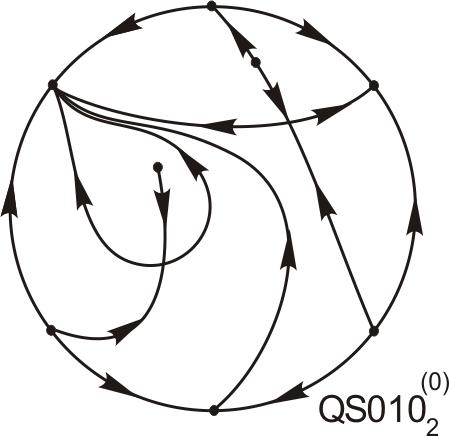
Phase Portrait
Topological Invariants
| TCSP | Fin Sep | Inf Sep |
|---|---|---|
| \(10\) | \(4421\) | \(411111\) |
Example
The quadratic differential system
\[\begin{cases} \dot{x} = y+x^{2}+3 \, x \, y \\ \dot{y} = e^{2} \, x/5-e \, y+x^{2}+2 \, (1+m) \, x \, y+(m^{2}+2 \, m) \, y^{2} \end{cases}\]
with parameters: \(e = -0.5, \quad m = 0.1\)
has the following phase portrait done with P4. If you want, you may download the P4 file here.
The phase portrait appears in the following papers
- With name \(Fig 5.203 S^2_{10,02}\) in {J. C. Artés, J. Llibre and A. C. Rezende}, Structurally unstable quadratic vector fields of codimension one, Birkhäuser/Springer, Cham, 2018, vi+267 pp.Note (for name \(Fig 5.203 S^2_{10,02}\)): The system has limit cycles with distribution \((0,1)\).
- With name \(S^2_{10,02}\) in {J. C. Artés, R. E. Kooij and J. Llibre}, Structurally stable quadratic vector fields, Mem. Amer. Math. Soc. { bf 134} (1998), no.~639, viii+108 pp.; MR1432139
- With names \(V4\) and \(V7\) in {J. C. Artés, J. Llibre and D. Schlomiuk}, The geometry of quadratic differential systems with a weak focus of second order, emph{ Internat. J. Bifur. Chaos Appl. Sci. Engrg.}, textbf{16} (2006), {3127--3194}.Note (for name \(V7\)): The system has limit cycles with distribution \((0,1)\).
- With name \(V4\) in {J. Llibre and D. Schlomiuk}, Geometry of quadratic differential systems with a weak focus of third order, emph{Canad. J. of Math.}, textbf{56}, no. 2 (2004), 310--343.
- With name \(V7\) in {J. C. Artés, J. Llibre and D. Schlomiuk}, The geometry of quadratic polynomial differential systems with a weak focus and an invariant straight line, emph{ Internat. J. Bifur. Chaos Appl. Sci. Engrg.}, textbf{20}, no. 11 (2010), 3627--3662.
Neighbours of Codimension 1
- Through the border \(QS11_{3}^{(1)}\), by means of a bifurcation of type \(B\), we reach the neighbor \(QS8_{2}^{(0)}\).
- Through the border \(QS76_{1}^{(1)}\), by means of a bifurcation of type \(C\), we reach the neighbor \(QS1_{4}^{(0)}\).
- Through the border \(QS38_{4}^{(1)}\), by means of a bifurcation of type \(A\), we reach the neighbor \(QS25_{1}^{(0)}\).
- Through the border \(QS38_{5}^{(1)}\), by means of a bifurcation of type \(A\), we reach the neighbor \(QS25_{3}^{(0)}\).
- Through the border \(QS10_{22}^{(1)}\), by means of a bifurcation of type \(D\), we reach the neighbor \(QS10_{4}^{(0)}\).
- Through the border \(QS10_{16}^{(1)}\), by means of a bifurcation of type \(D(c)\), we reach the neighbor \(QS10_{6}^{(0)}\).
- Through the border \(QS10_{8}^{(1)}\), by means of a bifurcation of type \(D\), we reach the neighbor \(QS10_{9}^{(0)}\).
- Through the border \(QS74_{2}^{(1)}\), by means of a bifurcation of type \(C\), we reach the neighbor \(QS5_{1}^{(0)}\).
- Through the border \(QS74_{12}^{(1)}\), by means of a bifurcation of type \(C\), we reach the neighbor \(QS5_{6}^{(0)}\).
Comments
This phase portrait appears in J. Llibre and D. Schlomiuk (emph{Canad. J. of Math.}, textbf{56}, no. 2 (2004), 310--343) featuring a weak focus of third order. Since the portrait is of codimension 0, a configuration structurally equivalent to \(QS10_{2}^{(0)}\) could potentially exhibit up to three limit cycles (or compound double/triple arrangements) bifurcating from the focus.